Teach the sounds first
Why a teacher of English literacy needs IPA — the International Phonetic Alphabet.
Letters and sounds map many-to-many. A teacher who cannot name the sounds apart from the letters is guessing at what they teach. So: first learn IPA — the actual sounds; then see the sound–letter mapping — unguessable!; then keep reading, as you learn words — with pronunciation AND spelling.
1. Learn IPA first — phonetic literacy!
Write with [ ]-brackets. Read what's in [ ]-brackets.
[ ]-brackets say, These are the sounds -- they can be trusted.
[ ]-brackets make you the scientist, the expert, the one who isn't guessing but actually knows.
Always use [ ]-brackets to write actual pronunciations.
In the wild when you see text without [ ]-brackets,
you must guess the sounds if you don't already know everything. Later!
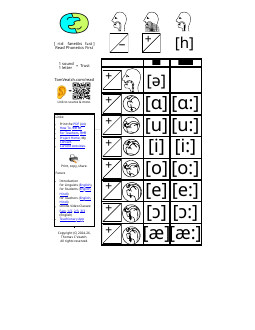 This
chart shows what your mouth actually does for each symbol.
Print it on paper, two sided, to share with learners from any language, who lack a smartphone.
Click on-line to enter the Teachionary memorizer, so you can hear and guess them all correctly soon.
This
chart shows what your mouth actually does for each symbol.
Print it on paper, two sided, to share with learners from any language, who lack a smartphone.
Click on-line to enter the Teachionary memorizer, so you can hear and guess them all correctly soon.
Another way: the nine more drills that teach basic, intermediate, and advanced IPA, as single symbols, in syllables, then writing what you hear.
| tap the symbol | in a syllable | write it down | |
|---|---|---|---|
| basic, universal sounds | 1 | 2 | 3 |
| intermediate, from English and Hindi | 4 | 5 | 6 |
| advanced, the rest plus some tones | 7 | 8 | 9 |
You can soon read and write IPA.
(Future work, a first-year-reading curriculum in IPA alone, so you can become comfortable writing, reading aloud or quietly, getting information and fun and confidence.)
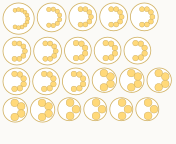 each sound → its spellings
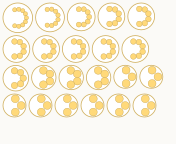 each spelling → its sounds
| Tom | Veatch |
| [tʰɑm] | [vič] |
Later you don't need to write IPA except to be clear with others, but you will just know what you are talking about, instead of guessing. IPA gets you over the hump into English literacy.
Phonetics, including the features drawn in the Instrument, should be prerequisite or the first part of English-medium teaching for the same reason. A teacher who can hear and name voicing, place and manner can explain a learner's error instead of simply marking it wrong. A human without phonetics is unaware of what they or others do and unable to discuss it. IPA First!

or point a phone at this