 ™
™
Notes on a Nomological Network
for [I], the "Optional I" theory of bliss
Abstract
Here I briefly summarize a nominal network or simplified conceptual structure underpinning experimental study of the [I] hypothesis, and outline classes of experimental predictions consistent with it.For [I] Theory: see Abstract and Ramifications, as well as an extended draft for this brief synopsis.
The emotional system is seen as importantly structured by the downregulatory effects of self attribution. If elements of circumstance are believed by a certain kind of organism to bear upon self, then the emotional consequences of the circumstance as understood are taken as binding by the emotional system which then implements that highly restricted feeling or emotional assessment.
This predicts emotional inflexibility, a sense of bondage, narrowed field of vision, a sense of inescapability of one's emotions, lowered sports performance, increased arrogance as well as suffering due to loss in social status, ingratitude, extended duration of mistrust, lack of forgiveness, less action in service to others, etc.
A Nomological Network
Figure 1 shows conceptual relations among environment and organism, stimuli, and internal processing of factual and motivational information leading to execution of a response.
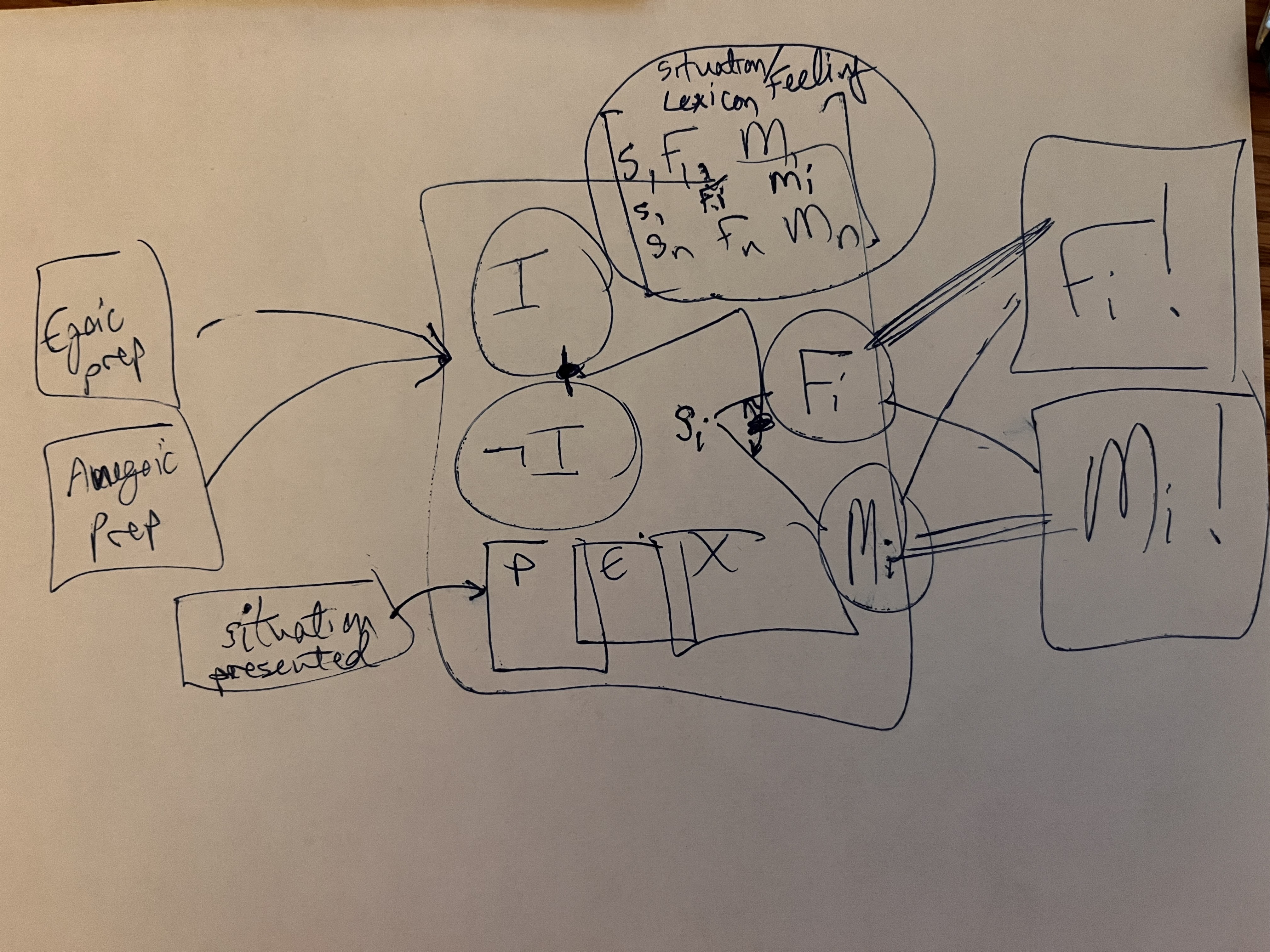
Figure 1.
The evaluation system can be modelled simply as a lexicon which maps situations, more or less abstractly considered, to motivational states, also more or less abstractly considered. As a lexicon it can contain any arbitrary association, conventional or otherwise. One would hope in the progress of science that a mere lexicon of emotion will become a grammar of emotion in which arbitrary factoids are replaced by general principles, but to temporarily capture all the Unknown Possibilities, we can think of it as a Lexicon.
In process terms when the evaluation system E receives from P an internal representation of the circumstances, s then it looks it up in this internal lexicon and pulls out the motivational category or pattern associated with that, or with that kind of, circumstance. Passing this assessment a on to X, the system executes its response as (hopefully for science) measureable activities.
In [I] Theory, the emotionally-evaluation lexicon returns a different feeling depending on whether Self is part of Situation. A verbose lexicon could list for each input two outputs \(s_i : F_i , M_i\), while the lookup checks if I is present if so returning F otherwise M. I expect there to be generalizations; and perhaps these are different situations, ¬I(s), I(s), looked up (in that order, I suppose) in different parts of a much smaller lexicon. But the drawing shows F, the egoic, and M, the anegoic response-feeling or motivational information or event, for each situation s.
Yes this is Quite Abstracted and cartoonish, but the Nomological Network straitjacket demands this. What I mean to say is:
[I] Theory predicts that experimental results will be consistent with at least some such differences.
Assumptions, notation, and some experimental variables
By emotion I mean prioritization of possible response and alignment of organismal resources thereto.I take as base (logical) model: "P|E|X". The Unix pipe symbol is here used to indicate the logical dataflow from Perception to Emotional Evaluation to eXecution. The logical data structures passed between these logical or analytic modules are Situation 's', and emotional Assessment 'a'. In short, the organism Perceives the (facts of the) situation, emotionally Evaluates them and eXecutes the emotionally loaded assessment.
P -> s | E -> a | X
Or
X(E(P())
P is a function of time and organism capabilities and state. P(t,o) = s. E(s) = a, X(a) is the emotionally-bound activity of the organism.
P and E may be distinguished only for analysis' sake; low-level factual perception may include valence, fast-reaction-time behavioral scripting, and emotion generally.
The awake organism is presumed to be in a continuous reevaluation loop of this sort, so that new and different data yield different emotional states and actions; new but consistent data yield support for the current actions.
Optional I, [I], theory adds to this the organism's optional consideration that in the situation may be features attributeable to self. Thus:
-
I(s) is notation indicating that some element of 's' is understood by
the organism as significantly bearing upon self: self has some
significant role in the situation. ¬I(s) =
∄es|I(s).
-
Given I(s), E and X (and feedback to P) carry out model-bound
emotional responses. The organism has some model of what being S or
owning S or having property S "is like" emotionally, and the organism's
emotional subsystem carries out that model exclusively.
-
S ⊇ status, action, responsibility, victimhood, fear, time, ...
-
I&S, (¬I)&S.
-
For Z in {$5, $62, $1250, $25k, $500k, $10M} ...
For s in status regarding {profession, morality, honor, ..,} ... - Suppose you (the subject) are engaged in E(s) with [I(s) | ¬I(s)], could Z distract you?
- Assertions triggering ¬I(s) might include {other(s), knownOther(s), friendOther(s), outgroupOther(s), s-irrelevant(s)}
- "Do you care about your SES, job prestige, etc.?" Imagine you lost your high-prestige|money|etc
job|degree|etc, what is it worth to you? Correlate degree of caring with (un)happiness.
- Measures among O-data, S-data, L-data and T-data could include:
-
- S: self-report answering such a questionnaires.
- O: describing another person in various distances to involvement, how would they feel? (control for empathy level) (vary age/adulthood(capacity)..)
- T: measures of stress, meditative brain waves, recovery time after watching, video stimulus could be VR, VR with shaking, big screen & sound variable distance to seat, black-and-white,
An instrument yielding a benefax values vector could be prerequisite or paraquisite for comparison when I(s) and ¬I(s).