 ™
A Master-Teacher Curriculum
for IPA First literacy acceleration
English | हिन्दी
% = share of common English words with that spelling where it has that sound.
| ||||||||||||||||||||||||||||||||||||||||||||||||||||||||||||||||||
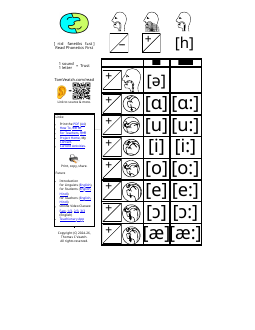
EssenceTry it first! Before anything else, look at the Instrument, top row. First there is a head, like any head, like yours. Start from left, go to right.
Teacher says: "I will do it. Look at my mouth now."That is what we do. This is how we write it. [ɑ]. Now you know [ɑ]. Now, again: [h] then [ɑ]: [hɑ]. Twice: [hɑhɑ]. Four symbols, one sound each; together they mean something: a laugh. You can read it phonetically (by sounds) because you know these phonetic symbols; so, you know how to say it. Because you understand what is said when you say it, you understood what is written: you read it. That is the whole idea: action in the mouth (phonetic reality), symbols to identify them (symbolization), sequence of symbols, sequence of sounds (segmentality), meaning. This is the essence of how to read.
IntroductionNow you know the essence. We can also talk about the idea and the doors it opens.
What IPA isFirst, what is the International Phonetic Alphabet? The idea of the IPA is to write all distinctive sounds of all languages.IPA defines phonetic symbols by the locations and actions which physically produce the different sounds of language in the human mouth. This is "articulatory phonetics". Gestures, locations, and actions in anyone's mouth sound identifiably similar to everyone: each sound from any mouth can be heard as the same as that sound from any other mouth. That's why humans can share spoken language. In this way, IPA is truth: basic, foundational.
India says, Satyam Eva Jayate: Truth Always Wins.We will try to prove it.
What IPA First makes possibleIPA First accelerates or enables many paths.If IPA is known there can be no such thing as an unwritten language; write it with IPA; share it; now it is written. If IPA is taught then correct learning theory is followed and learning is accelerated. Teaching should build on or extend existing knowledge. The existing knowledge is the student's knowledge of the sounds of their own language, in which they are experts. The extension that gets built is that student learns mere labels for those existing sound categories. The learning is nearly trivial; entirely trivial except that some new fun sounds get to be learned, since no language includes ALL the sounds of all the languages; and that some languages ignore some differences; the babies learned to not perceive clear and audible differences. A practical subset might include one's own language's sounds plus those additional sounds that adjacent languages might use; adjacent in geography or history or even interest. But it's fun to learn the whole set: Why NOT learn the voiced bilabial trill, [ʙ], or various click sounds? It's fun to be able, or at least to try, to do everything that humans can do! If IPA is learned (first!), every language can quickly be learned, because you already know the different sounds that occur in that language, which are merely examples of what you know from the IPA. The sounds of each language are a subset of IPA sounds. Because IPA includes English (lower-case) letters, most English street-signs can be read using IPA pronunciation once you learn the IPA, imperfectly but usefully: when you recognize the signage (and even a bad guess can be recognized on the sign), then you have arrived. Every script and every word in every language is easily defined using IPA. Modern dictionaries use IPA for the pronunciations of words. IPA is the ground. To learn any script, learn IPA first, then see how the script is defined in IPA: easy! For example, see Devanagari. IPA First means that for those who have limited time in school with teachers or limited technological support, a phonetic alphabet offers a learnable, phonetically accurate writing system with worldwide coverage.
The innovation: cartoonsIPA is old. The innovation here is simply to relabel these charts of symbols with cartoons.Cartoon pictures (mechanical line drawings) show the distinctive features of the International Phonetic Alphabet. Thus we remove the requirements of academic vocabulary (and entrance) such as "fricative", "velar", etc.. We loosen the requirement of school based learning so that anyone from prisoners to isolates to the urban poor can either self-study this content or learn it with minimal support or learn it on-line. A little explanation, few classes, can put the student on the path to figuring out the basics themselves. Phonetic drawings make the IPA letters' phonetic features clear to nearly anyone (not if they are blind, not if they can't understand cartoons, say age 3 or 4) including any illiterate or semi-literate schoolchild or adult. Drawings may make a phonetic alphabet self-decodable even when picked up from a dispenser on the road. They can certainly be strange-looking before you take them seriously and actually use them. But then, they turn out to be excellent study aids for students and teaching aids for in-person teachers. They clearly, unambiguously, show voice, gesture, action, and location; that is, how the sounds are made and therefore what the sounds really are. (And TomVeatch.com/read has apps to listen/learn/test yourself for homework or in class.)
How it spreadsIPA First could potentially solve the world illiteracy problem (745 million illiterate adults by UNESCO's 2015 count, 3000 unwritten languages) at scale if it can achieve virality through the social networks.Master-Teachers trained with this Curriculum can teach the next generation of Master-Teachers and Teachers (in any language). Then, either of them can Teach any illiterate or semi-literate person, child or adult. Since one who has learned can also teach, hopefully this system will indeed become viral so that everyone, worldwide, will soon have the chance to learn to read and write their own language (and others).
Curriculum StructureThis Master-Teacher Curriculum includes these enumerated, nested chunks of information:
To be a successful student you need Levels 0, 1, 2, 3, 4, optionally 5 and E: perhaps 6 classes of 30 minutes, plus practice according to your desire. Your goal is to read as comfortably as you talk. To be a certifiable teacher you need that plus Level 5 plus Teacher Training: a couple more classes of 30 minutes. Your goal is to create successful Students who can read and write with a phonetic alphabet, one sound for each letter, and once they have basic literacy to go on the lifetime learning path of self-study. To be a certifiable Master-Teacher you need all that (0-4, 5 and E, Teacher Training) plus Master-Teacher Training; perhaps 2 more hours. Your goal is to create successful, effective Teachers and Master Teachers. The February 2025 version: TeacherCurriculum-2025.php. Teachers: read Teacher Training before your first class. LessonsLevel 0: The Essence above is Level 0.Teach [h] like this: point to the head; make the loud out-breath; explain: "That is what you do." Point to [h]; explain: "That is what we write." Teach [ɑ] like this: point to the jaw arrow and explain: The arrow says "Open". Demonstrate it first without voice; ask them to look at you. Interrupt yourself. Teacher says: "I made a mistake. I did this, but I didn't do the voice part; let me try again." Open the mouth, briefly do the voicing: that's it! Again. Teacher says: "I have to do both; one is not enough. The pictures say what we do." Point to [ɑ]: that's what we write. Now the teacher writes [h ɑ] = [hɑ], says it, then twice, [hɑhɑ], and asks what it means. Teacher says: "You read it." Level 1: Smiley-face; [- + h]; []'s; [ə]; V height & length; C actionHow to actually write and readSmiley-face (Writing 1.1)Give out notebooks and pens. Without, there can be no practice, little learning or success.Draw smiley faces. After one, do more. Practice till you like it. Keep students actively doing something wherever possible. A student who writes, learns.
[hɑhɑhɑhɑ]: (Writing 1.2)Encourage writing since action teaches best.Show "h" stroke order: vertical, shoulder, arm. To write, practice every letter, write on the line, check stroke order and direction, write while saying it aloud, then easy words like "baba", then harder words as able. Write [h h h], say [h h h]. Practice until you like it. Write [ɑ ɑ ɑ], say [ɑ ɑ ɑ]. Practice until you like it. Already you can read and write something: [h ɑ h ɑ hɑhɑ hɑhɑhɑ]:
Now or later at home,
Explain reading and writing:
Square BracketsWrite IPA inside [ ]: the brackets say "this is sound, not spelling". Always. [- + h]: The Three Glottal StatesSee the Instrument, first row of three heads:
What is +? (Voiced) What does it mean? (action in larynx, vibration) Practise outside class with an app: Basic Symbols with Sounds. Name vs SoundThis "[h]" letter,
Vowels #1: [ə], vowel length, vowel heights[ə]: Home for VowelsSee the Instrument, 2nd row. the first vowel: [+/] (Voiced) and a head with no action. This is a vowel named "schwa". Its sound is like waking up [ə], or going to sleep, [ə]; it has no action to spread or squeeze anywhere.Schwa is like home for speech. With no constriction or special movement; the vibration is equal, cross-sectional area is equal throughout. The mouth generally goes back to schwa after speaking, starts at schwa before speaking. Speech is basically actions and gestures that start from schwa, move away from schwa, and eventually move back to schwa. Even in Devanagari it is the default vowel, अ, [ə].
LengthTeacher note: Point to the short black rectangle, saying "this means less."Point to the long black rectangle, say "this means more." So [ɑ] short, [ɑː] long. [u uː, i iː, o oː, e eː, ɔ ɔː, æ æː]. Teacher note: Demonstrate them all, repeating them; students should repeat with you for each one. Okay? They should nod if they got it, but you want to hear them say it. This is a good time fo everyone to pronounce all 15 vowels, before teaching all the symbols.
Height: three degrees of vowel openingNext explain the features by inquiry on the easiest example, [ɑ]:
Teacher says: Observe the down arrow. This has a name, the name is "open". Where else is the down arrow, "open"? (Answer: e and o)
Three kinds of down-arrows: none [i u], regular [e o], and big [æ ɔ]. Linguistics calls these as degrees of opening or of height: high, mid, and low. Say them in order by height and feel the jaw open one step each time: high vs mid: [i e i e] [u o u o]Now we have done Names vs Sounds, 3 states of the glottis; [ə] as home for speech; length; and height. Last in this lesson is Consonants, which have some kind of an action at various different places. Consonants #1: actionsWhat actions can you really do in your mouth? We will list the same things over and over four times. First: the possible actions are variations on closing and opening. Close-fully-then-pop-open, close-holding-nose-open, close-and-open fast (bouncing), nearly-close while blowing so it hisses, close or blow not quite that much (like a high vowel but at some location), close in the middle but not the sides. That's everything. We discuss the actions, before any places. Actions are abstract but simple when taught first. These are things you can do with the tube of your mouth. Second: do each one with them; then of course they can:
Third time, let's look at the 6 action drawings, left side of page 2 of the instrument. Five of the six actions use a drawing of some kind of a tube (the nasal, is drawn with the nose and comes in Level 2). The tube represents the airway with air flow right to left, as in the drawing of the head. In the middle of this tube is some kind of a doorway or closing or obstruction which might be your tongue or lips doing something for an audible effect at some location or other. Each action could occur in each place, we say. Fourth pass: In the five actions five different kinds of obstructions make five different kinds of sound effects.
StopsIn the case of stops, there is full closure at the place, and suddenly the door opens.The arrow down and outward indicates this opening action. This action has a name in English, the name is "stop". (Hindi rok jao). What stops? Air flow. Easy!
FricativesFricatives are like this (blow into fist or between thumb and forefinger making a hissing noise by obstructing the airway. Not a whistle, but a hiss. It is where there is a small path, and the air breaks up and tumbles. We call it frication, Do you see how there is a small groove in the drawing for the fricative action? And do you see the turbulence downstream of the groove? That is to indicate a fricative by a physical analogy. Turbulent air mixes and does not move in parallel lines, so the drawing shows movements in all directions in the middle of the airstream. It is unambiguous to those who know, but I just hope those who don't know can also figure it out.If you are going to teach this stuff, if the idea of frication cannot stick in your mind try instead remembering that the third action is [f, θ, s, ʂ, š, x], plus their voiced alternatives. Then you're set.
FlapIn the flap action, the tongue makes a bouncing, as we say, Ballistic, like a bouncing ball, contact on the upper surface of the inside of the mouth, hits it and bounces off. The drawing of the flap action has an arrow that closes AND opens indicating this bouncing which is importantly moving in BOTH directions, unlike a stop which sits for longer in the closed position and doesn't exactly bounce quite as fast.
Approximant or GlideThis action usually includes only [y] and [w], palatal and labial.Do I have to discuss [y] and [w]? Glide or Approximant means that there is a small opening, not so small that it hisses, but still quite small, and through this opening goes all the vibration and resonance of the vocal tract. These are actually nothing but extreme vowels [i] and [u], but languages use them for consonants. You might write [ɑi] or [ay] and the difference would be insignificant, or you might say conventional. Use either convention, both are available.
LateralFinally we have the versions of [l], "ell". [l] involves a small pathway around the side of the tongue, so the Latin experts gave it the name lateral, meaning around the side.Recognize "clear ell": [l], and Marathi retroflex ell: [ɭ]. To get American English properly youll also need velar or "dark" ell: [ɫ]. Practice practice. For the teacher, about the drawingsActions are not easy to describe so we try names and descriptions and drawings. We will do our best. Also improvements in these drawings are requested from the public.My job here is to explain what each action is like, physically and how each drawing works. The dashed lines on the downstream part of the tube after the doorway suggest the place could be at the lips and if so there is no downstream tube. In that case ignore dashed lines as imaginary. But in the other locations, the doorway is located inside the mouth, and the dashed lines indicate the entire downstream part of the tube after the obstruction out to the lips.
Level 2: vowels forward vs backward; the five places by bursts, then nasals, tone, and CVC practiceVowels #2: forward vs backward, at lips or tongueWe learn sounds in contrasts. Vowels come in pairs or triples that differ in one thing. The Basic Vowels have three gestures (a.k.a. features or gunas but here, sets of arrows), one each for [ɑ], [i], [u]. We already did [ɑ], now let's do [u i u i]. Repeat after me [u i u i u i]. (Check everyone is doing it, encourage the shy ones to really do it, no, really.) Do you notice the lips moving? Do the lips move forward and backward? What about the tongue can you tell the tongue moves backward and forward? Everyone should be in agreement then, [u] to [i] is lips forward, tongue backward, to lips backward, tongue forward. So, do you see that is what the arrows say? Look at the pair of drawings, what is the difference? Teacher can use hands near face one in front representing lips and one to the side representing tongue, and show an iconic movement of hands apart with [u] and together with [i]. To review:
Consonants #2: placesWe show consonant location as five places by demonstrating with the voiceless stop bursts. Repeat until they do it too, then next, for each one, following the place drawings.
Ask the students to listen as you produce voiceless burst sounds from each place of articulation, with finger moving to each Place drawings. [p p p, t t t, ʈ ʈ ʈ, č č č, k k k]Then train by testing:
Train by testing, with stop burstsTeacher indicates different places in random order: make the burst sound3x, pause for student to think about guessing, then point to the answer. Do each in a round once through.
Teacher test in random order: burst 3x, ask student to point to the answer. If they got all, explain what they have done. Teacher says: "You know all five places!"
The Nasal Proof: [m]First I will explain the idea of a nasal.
Make the mmmm sound (listen so everyone does it).
Teacher says: "Watch me stop it. Say mmmmm... and Pinch the nose." (Note to Teacher: watch them do it.) (If time, try with [n, ɳ, ñ, ŋ]. Is it true that they all need the nose open?) So these require nose open because nose closed finishes them. Because they need the nose, we call them nasals, in every place. Okay? That is the first action, nasal. Now let us do the first letter [m].
Teacher says: In [m] is there voice? h,-,+? Wait for Yes. See [+] means voice.
The nasals at the same five placesNow the nasal at each of the five places you already know from the bursts: [m, n, ɳ, ñ, ŋ].Can you see the arrows, produce the sounds, and percieve the sounds as being at those places? [m, n, ɳ, ñ, ŋ]. Note to Teacher: test with random ones: is there voice, is it nasal, what is the place? See the drawings, point at the place for [m, n, ɳ, ñ, ŋ]. Say each in multiple syllables with schwa: [mə mə mə], [nə nə nə], [ɳə ɳə ɳə], [ñə ñə ñə], [ŋə ŋə ŋə].
Teacher says: "Now you know [m, n, ɳ, ñ, ŋ], all the places, and one action." Location or Place:
labial vs dental: [m n m n] (not too fast)Action or Manner: nasal vs stop: [m b p] [n d t] [ɳ ɖ ʈ] [ñ ǰ č ž š], each 3 to 4 times The 4 tone marksWhat the Instrument offers you is 4 clear phonetic tone patterns, high, low, falling, rising, marked by a diacritic, above for high, below for low, rising "acute" for rising, or falling "grave" for falling. (Acute and grave are the French names for these marks.) Just remember left to right and high is up and low is down, then you can draw these diacritics correctly without thinking more about it.Here, I am satisfied if you simply recognize the phonetic values here: say some vowels each with high, low, falling, rising, see that each vowel can have each tone separately.
Practice: CVC reading and transcription (voiceless stops plus h and any vowel)Teacher can give them, app can give them, students can give them also especially in their own language or Sanskrit or varied sources.Teacher can ask everyone to write following an example, later by their own opinion, and for each to read Teacher's writing aloud too.
Level 3: the lax vowels and the vowel triangle; the rest of the consonants, easy to hard; CVCVC practiceVowels #3: the lax vowels and the vowel triangleTeach the lax vowels [ɪ] (as in "bit"), [ɛ] ("bet"), [ʌ] ("but") and [ʊ] ("put"), each by contrast with its neighbours: [u ʊ], [i ɪ], [e ɛ], [ə ʌ ɑ]. Then the whole vowel triangle, with the lax vowels in place among the others.
Consonants #3: the rest, easy to hardTeach the rest of the consonant table in four groups, easiest first:
How to make each of groups 2 to 4 is in the table of difficult consonants below. 1. Native: the drillsAll these sounds have a place and an action. One place can also have different actions.Actions are 6. Point the finger down the retroflex column pronouncing each one: [ɳ, ɖ, ʈ, ʐ, ʂ, ɽ, ɚ, ɭ]. Compare [p,k], what is different (place) what is same (stop, voiceless).
Place and action drillsContrast 2 places with 6 actions. Each of two places can use the same action for 6 different actions: [ ɳ ñ, ɖ ǰ, ʈ č, z ž, s š].
Now try all actions at labial place m p b f v w. Same location but different action!
Teacher says: In one place we have [kə gə ŋə], what are the actions?
Different from [ŋə]? Yes, [ŋə] is nasal.
Does it create [g] and [k] when voiced and voiceless?
Teacher says: Can you do a stop at the lips? Voiced and voiceless: [b, p]. Teacher says: "It's time for practice, then a break, then later we can do more explanations."
Practice timePractise outside class with an app: write what you hear. Write each new letter as in Level 1, saying each out loud.Now write [nɑ, nɑmɑh, hɑm, mɑːhɑː, nɑːn, nɑːnɑː, mɑŋ] (name of [dɑːl]), [mɑn].
Practice any local or English word, students' choice (any CVCVC combination): one student asks for a word, everyone hears it, writes it, discusses it, and reads it back.
Note to Teacher: the difficult consonants
The stories behind these sounds are under Level 5: Notes on the difficult consonants. Level 4: review of vowel triangle and difficult consonants; testVowels: review the whole vowel triangle from Level 3. Consonants: review, practise and test the locally difficult consonants (the list is in Level 3): read and speak, hear and transcribe. Practise inside class with words volunteered by a student. Stand up, say it, half write it, the other half reads it, the first is judge of correct pronunciation. Practise outside class with an app: more sounds, in words. Level 5The rest of actual IPA is left out of the Instrument. Vowels whose lip-rounding goes against the usual pattern: tongue forward with lips forward, [y] and [ø] (French, German), and tongue back with lips back, [ɯ] and [ɤ] (Japanese, Korean, Turkish). And the adjuster marks (diacritics): small marks added to a letter to change it a little, such as breath after a stop [pʰ], a nasal vowel [ã], and length [aː]. Or raised, lowered, fronted, backed, according to their diacritics. The full chart is at the International Phonetic Association. This course's letters and the official IPAThis course writes some sounds the way American linguists have long written them (the Americanist tradition), not the way the official IPA chart does. Both are in use; a learner who reads one can read the other with this table.
Practise outside class with an app: write what you hear, harder. Tone languagesMost languages are not tone languages which distinguish words by tone. In India as far as I know, only Punjabi and Chinese-related Tibetan and Tai languages have tones. Instead, most languages use tone or pitch not for word-tone but as part of sentence intonation, as in: Rising, for a question; Falling, for the end of a statement.Among tone languages we can say Chinese understands [ma] in four ways depending on tone, and they call their tones by number, 1st, 2nd, 3rd, 4th. Cantonese and Vietnamese have 6 tones. Thai has 5 but writes 3 in its spelling. If you have a tone language you will probably have to figure it out for yourself. These 4 patterns may be useless in two ways. First, your language may not be a tone language. Then please ignore these marks. In this case, please be happy since instead of "colon" [:], you can use the macron overline diacritic to indicate length, which is common in writing non-tonal Indian languages in a Roman- or English-like alphabet. Second, even if your language is a tone language, very probably, it does not use these particular tones. In that case please invent some diacritics to put on or near the vowels or syllables. (IPA likes to tone-mark the first sound, usually a consonant, in any syllable, but that is dumb because in spectrograms you can see that actually it is the vowel that carries almost all of the tone, so why tone-mark letters that don't carry tone?!). In short with tone you can do what you want, and these diacritics are some hints about some things you can do. Do what makes sense to you, and maybe cooperate with others to form a consensus on what works for everyone. If possible I'd prefer to skip the tone marks and instead use punctuation like [?,.] for:
Notes on the difficult consonantsSo [f, v] are not exactly (bi)labial but labio-dental. See the upper teeth; see the lower-lip touching the upper teeth. If you don't see the teeth ask Show your teeth. Then you'll hear the right thing. Japanese has a bilabial fricative [ɸ] not included. [f] is not a big error for Japanese.)English got a pair of sounds from the invading Vikings which is written with greek theta [θ] and norse thorn [ð]. These are not Hindi [th] which is a stop plus h aspiration. They are linguo-dental fricatives, and easy and fun to make. Stick your tongue through your teeth, then blow with or without voicing. It works! In Sanskrit there were three fricatives with the tongue: one more dental, one more retroflex, and one more palatal, all three different voiceless fricatives, but in every descendant language they have merged into either two categories or one, and we could put these symbols in different places. For me I like [s, z] for dental/alveolar, and [š ž] for the palatal mark reminding me of the palatal glide [y]. Sorry I don't like Leibnizian tall S [ʃ] for [š], it seems like a special occasion letter, for a regular daily sound, but some phoneticians prefer it. Finally many languages lack the velar fricatives [x] and [ɣ]. Hindi and Urdu speakers already have them from Persian words like [xɑn] (khan) and [ɣələt] (galat), so start there. Ignore them if you don't have them, but if you want to be a phonetician you should learn a little German or something which has them. Frication can be very loud [s] or very quiet [θ] or deep in the mouth [h] or out at the lips [ɸ]. [f] is often indistinguishable from silence, inaudible. In language, we teach ourselves to move our tongues to make this narrow path and we raise the pressure from the lungs to make such turbulence, and a few different such whistle-like sounds can be made, not exactly in the expected places to match the stops and nasals, but near enough to identify with those places. In the dental-alveolar region it is written with a flap symbol [ɾ] but strict IPA actually uses the [r]. Behind that in the retroflex region, we use the retroflex indicator, a long tail with a hook, attached to the IPA [r]. If there is more than one contact, a multiple-bouncing-ball, the name for that is "trill" as in certain birdsongs, but I write that as if with a single flap. I am open to correction. There is another place of articulation for the flap, which is velar, or uvular. Actually it is a uvular trill, written with a capital R in the IPA. I cannot do it without frication, but native speakers of French and German do the most amazing job of it. Listen to Edith Piaf singing Je Ne Regrette Rien and try it yourself. Meanwhile I don't know if anyone else will need [ʀ], but it is there since it is part of IPA. A "flap" sound is the most typical sound for the various sounds we refer to as "r" or "R" (although in US English "r" is normally pronounced [ɚ] which I called a glide in Veatch 1991. But in two weird languages which happen to be politically important, American English and Beijing Mandarin Chinese (and in nowhere else in human language as far as I know), there is a retroflex approximant or glide sound [ɚ] which the rest of the world finds impossible to pronounce. So if you need this IPA letter for any other language please let me know, I will be very excited. On the other hand I wrote a lot of my thesis about [ɚ] so I couldn't exclude it without a twinge in the heart. Really it is an amazing sound. And there is the so-called velarized ell, which is what I'll use for American English velarized "l" as in "well". In my thesis on the Chicago dialect I have made hundreds of measurements of the sound of this "l" as in "well"; it can swallow the following "e" and together they can become indistinguishable from [ʊ]. But consider Polish, which has palatalized and velarized laterals. I didn't include a palatal lateral, sorry. If you need it let me know. But I think all these could go by "l" without any trouble, so fewer options is less trouble for beginners and here is the balance I have struck for now. Hence laterals. English ell is rarely this nice clear [l] which has tongue tip closure and no tongue-body retraction, as in Jamaican Creole [l] or Hindi [l], so don't get excited if you are an English speaker. There is a retroflex l in vedic Sanskrit and some descendant languages such as Marathi, so that's there with the retroflex tail.
Level E: EnglishThis section is provided for students interested in English.
English steps:
English vs IPASadly the English letter NAMES are different from their SOUNDS as IPA letters. The name of "h" is "aitch"; the name of "e" is pronounced [iː]; the name of "i" is [ay]. The English pronunciation for a letter is often different from the name of the letter. "h" which has the name "aitch" is never pronounced anything like [eːč]; in English spelling it is often deleted, or deleted while changing another letter's sound. English literacy is troublesome, even for English speakers. It's fun to learn, but it will take a while.For a first guess you can use IPA pronunciations to read English text. English letters are all part of the IPA, and using IPA sounds for them is usually wrong, and often really terrible, but very often IPA gives a serviceable, temporary guess. It's okay to start, if you will remember this is a normally-wrong, often terrible, wild, wild guess. Then take responsibility to listen for that word pronounced by a trustworthy model (or look it up!), and THEN you will always know exactly how to say it, for the rest of your life. So you can Very Temporarily pronounce English text as if it were IPA text. Just remember, temporary is temporary, and always pay attention to fix your wild guesses with something true. Now, to talk ABOUT letters and spelling, you can use the English letter names if you and your listener know them. I really apologize for the mess of the English language, which is the cause of all this complexity. I wrote 330 pages for a PhD dissertation named "English Vowels", so I have suffered more than you will. Educated English speakers will be confused by IPA sounds when they expect a letter name, so someday you can learn them: sing the ABC song, watch YouTube and sing along. Then you can give those English speakers an easy time by using their arbitrary and nonsensical names. May I share something fun? As mentioned the NAME for the letter "e" is pronounced [iː]. This came from the long history of the English language, over 600 years ago, in a sound change called the Great Vowel Shift. Someday, please read about it and then English spelling will make a little more sense. Okay, enough. Conclusions: To speak out loud, you may use the IPA letter SOUNDS as temporary guesses. To write clearly to confused readers you may write with double quotation marks for English spelling and brackets for IPA as in This is the normal practice of properly educated linguists: Just put brackets around your IPA writing. [] means Phonetic Transcription. [] means IPA. We can also use // for language-particular sound transcription, but we start with [] which is the reality and foundation. If you write phonetically without []'s people think you are uneducated or crazy. But as soon as you use [] it means you are a scientist, an expert; you actually know; whereas, other people are guessing. A 5 year old writing without []'s will make the parents question the teacher's sanity, but with []'s they will be Very Impressed with their child's brilliance, depth of linguistic understanding, and scientific accuracy. Always use []'s for phonetic writing, so people know how to read it.
To learn moreKnow why:Literacy is motivated for: messages, travel, and transactions.Transactions: Write receipts, exchange agreements, contracts. Your will after your death. Put your name on your stuff. Buy and sell with a written receipt or a contract: write it down now to defend it later, and own what you own.Travel: Where are you? Directions, signs, maps say where.Messages: Write letters to your people. Your will after death, a family history so that your descendants won't forget you. Family recipes. Post signs for others to read. Write poetry, stories, your special knowledge: share it! How to LearnThe trick of learning is to find something so simple and easy that you already know almost everything, where you can figure out the missing part.The reason babies can learn language so quickly is that it is so easy to speak to them at their level. Also their utter lack of comprehension, the low expectations, and the great clarity when they actually learn something new, these all support the adult in talking to them in the simplest language within the edge of their knowledge where babies know almost everything already.Every sentence, that has only one unknown feature, teaches it to you if that feature can be understood from the rest. So seek out simple things to read, and put on your learning hat. The path to excellent reading -- comfortably as if talking -- is to read and read, and keep reading forever, going from easy to difficult material. An excellent reader moves the eyes freely around the text, picking up definite clues from unambiguous letters and known words and combining clues with knowledge of context and activities being described. An excellent reader extracts clear unambiguous information by scanning for those definite clues, then inferring what else must have a certain meaning for the whole to remain meaningful. Then even the unknown becomes known because its meaning is evident from the context. Be patient and curious; tolerate your own partial ignorance as you learn. No one can know or learn everything, just as YouTube receives more than 24 hours of uploaded video each day, so no one can watch everything. Still, you can learn anything you want. I encourage you to keep using what you know, keep learning new ideas, words, scripts, and languages. Mine are Hindi, Sanskrit, and English, and any language of the place that I am staying. Maybe you could learn those. Don't limit your future based on your present. Learning builds upon itself so if you keep learning there is no upper limit to your personal knowledge and capabilities. My gift to you is the International Phonetic Alphabet, IPA: learn it, share it, and ask those who learn it to share it (the reasons are in the Introduction).
Teacher TrainingApproachThe Teacher's approach must be first to love and respect your students.
MotivationsThe motivations are Travel, Messages, Transactions.
ScriptsScript is not language.
Here we have 3 Scripts: Devanagari, English, Phonetic. What shall we learn first?
The first step needs to be simple, practical, accessible and safe.
Devanagari is hard to draw phonetically: one letter /kha/ is 3 sounds. Not 1-1! A Phonetic Alphabet is simple, easy to draw, write, read: 1 sound 1 letter: 1-1! A Phonetic Alphabet also helps read English immediately, with adjustments. Signs can be read usefully. .. also helps learn Devanagari easily and accurately. .. also helps learn ANY language, write ANY language (including unwritten languages!)
Teacher's checklist: before, during, after
Master-Teacher TrainingMaster-Teacher ExpectationsAs I write this in 2025 I am light on expectations. I think this will mostly happen by itself, like a wildfire, once a certain spark catches. But it is important to set expectations, so here goes.
Master-Teacher TasksNow, the Master-Teacher's job is to (1) find, (2) motivate, (3) qualify, (4) teach, and (5) test new Teachers, and (6) collect results and report to us.
Master-Teacher To Master-Teacher TransmissionAfter training a teacher, how do they become a Master Teacher? Give them the above material which you studied to become a Master Teacher. Discuss it with them; ask them what they got out of it; test them on it.Become their colleague and advocate. You know them, what do they need to become responsible, successful, effective? Just think about it and I'm sure you will figure out what is needed. Do the right thing. Connect them with Phoneticians.com where we will be testing Students, Teachers, and Master Teachers on their relevant capabilities, so we can certify folks at each level. Ask them to collect data and return it to our central repository where statistics are kept to show the spread and progress and effectiveness of this work. If your student-teacher knows the material, authorize them to teach it. Why shouldn't a child be able to teach his or her parents and grandparents what they learned? Will it benefit the recipient? If so, we should encourage it. But also point out the responsibility of a teacher to know their material and speak the truth, not to exaggerate or oversell or lie. Also please try to be available to advise them as they may encounter difficulties. Share what you learn with the rest of us as well. I consider this a learning community, so let us help each other to learn, and share best practices, and accelerate the good things that may come from our efforts. And may the world be delivered from involuntary illiteracy.
|
